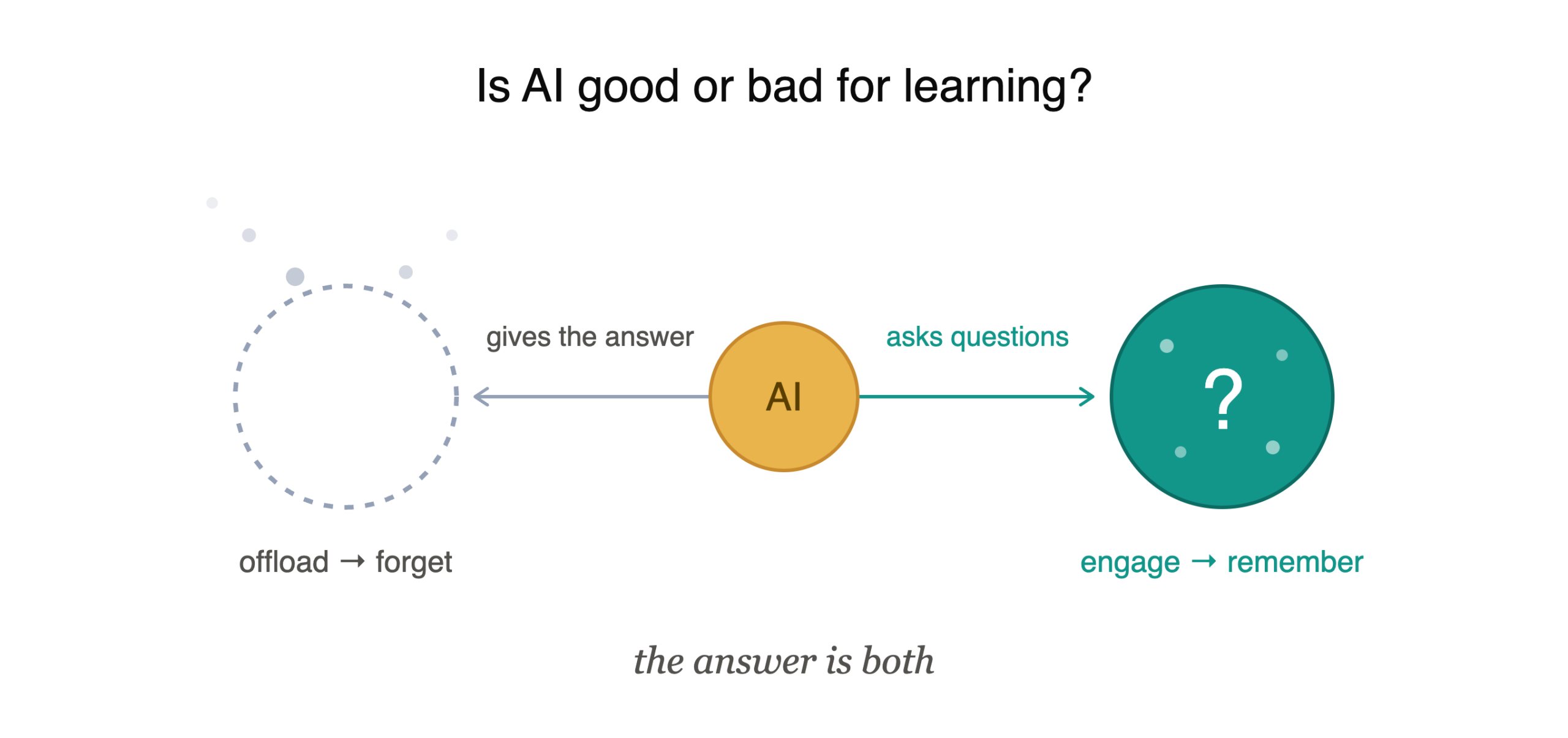
It’s such an interesting question, because the answer is both.
We’re seeing some really interesting studies right now (I’m sure a lot of you have already come across them) showing that people who studied with ChatGPT remembered far less than people who didn’t. (See link below) The simple version: when we hand our thinking over to the tool, we skip the mental work that makes things stick. We save the effort now and lose the memory later.
But here’s the part that fascinates me. The same tool, used differently, can be great for learning.
We’re also seeing studies on the Socratic method, where the AI asks you questions instead of just handing you the answer. LearningEdge has a Socratic feature built in. Claude for Education’s Learning Mode does something similar. It guides you toward the answer instead of giving it to you, and it’s doing some really interesting things for retention.
I love exploring how different people use AI to learn. I use it constantly myself. When a concept doesn’t land on the first pass, I’ll ask it to reframe the idea for me, and seeing it from a new angle is often the thing that makes it finally click and stay in my head.
So I’m going to keep looking. The Socratic method is a strong start, not the finish line, and I want to find more of the design choices that help people actually remember what they learn, not just receive it.
Sources:
Studying with ChatGPT and long-term retention (Barcaui, 2025): https://www.sciencedirect.com/science/article/pii/S2590291125010186
LearningEdge (MindEdge): https://mindedge.com/learningedge/
Claude for Education, Learning Mode: https://claude.com/solutions/education